
MAJOR CHANGES IN THE EU CLASSIFICATION, LABELLING, AND PACKAGING (CLP) REGULATION – WHAT ABOUT KKDİK AND REACH?

MAJOR CHANGES IN THE EU CLASSIFICATION, LABELLING, AND PACKAGING (CLP) REGULATION - WHAT ABOUT KKDİK AND REACH?
The European Commission published a new Regulation on October 23, 2024 (Regulation 2024/2865), introducing amendments to the CLP Regulation. This new Regulation consolidates recent updates, such as the addition of new hazard classes, which have been introduced hurriedly (!) over the past years.
The key changes in the content of this Regulation are outlined below. Meanwhile, if Turkey’s stalled registration system is reopened, registrations with incomplete content or hazard classes compared to the EU will likely be made. Turkey’s SEA Regulation currently aligns with the 13th ATP, while the EU has reached the 22nd ATP level. The differences between these ATPs may result in incomplete or incorrect registrations due to missing evaluations of substances listed in Annex VI. It is therefore critical for Turkey to update its regulations as soon as possible to prevent repeated revisions of registrations.
Evaluation of CLP 2.0 Regulation (REGULATION (EU) 2024/2865)
Below are some of the key issues that stand out in the amendments. As always, we recommend reviewing the original text (source).
1) Distance sales
For products marketed via online marketplaces or similar means, it is required to have a supplier established within the EU to ensure compliance with the requirements of Regulation (EC) No 1272/2008. (Article 48a)4) Evaluation of multi-component substances and mixtures
Under the current state of science, it is challenging to adequately assess the endocrine-disrupting properties, persistence, bioaccumulation, and mobility of multi-component substances or mixtures based on data related to the substance or mixture itself. Therefore, as a rule, data on individual components of mixtures or multi-component substances should form the basis for hazard identification of such substances or mixtures.Annex II, 3.4. Supply through refill stations
Suppliers must ensure compliance with specific conditions when hazardous substances or mixtures are supplied under Article 35(2a).‘SECTION 5: HAZARDOUS SUBSTANCES AND MIXTURES SUBJECT TO ARTICLE 29(3)’
Ready-mixed wet cement and concrete must be accompanied by a copy of the labeling elements in accordance with Article 17.Annex IV, Part A
Provides the dates of application.
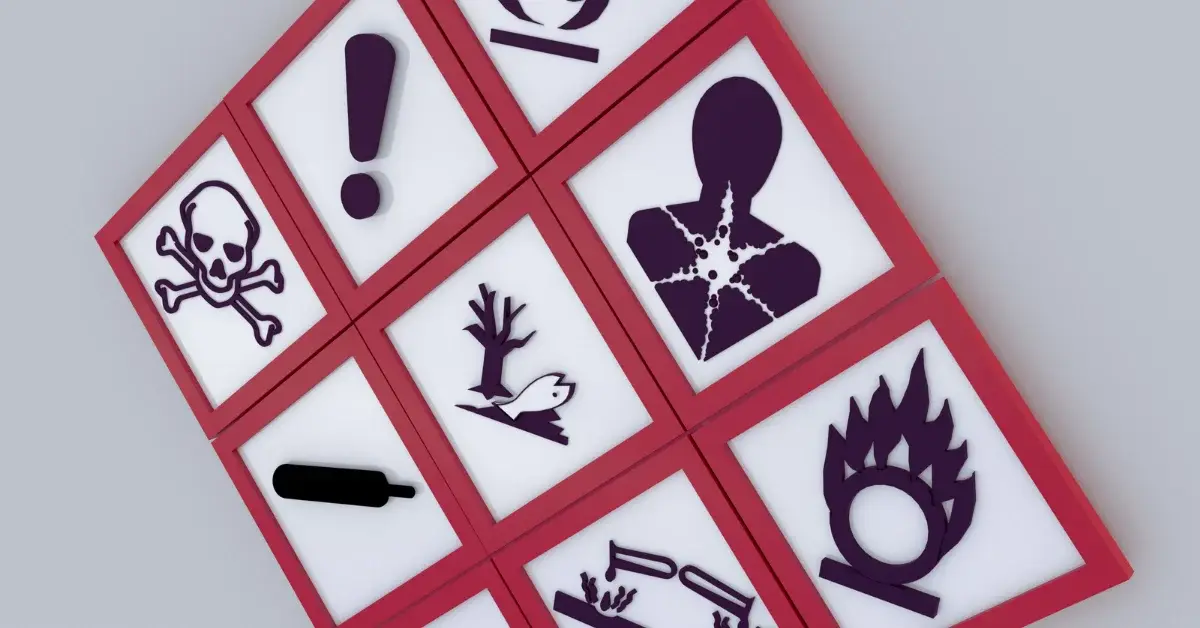
Classification of Hazardous Chemicals
- Article 4: Updated to allow for classification based on the physical form or state of substances or mixtures while ensuring no lower classification than specified in Annex VI, Part 3.
- Article 5: Introduces new rules for the classification of multi-component substances and complex mixtures, particularly for endpoints such as CMR, ED, PBT, and PMT properties. Substances derived from plants or plant parts are exempt, with further guidance expected by December 11, 2029.
- Article 10: Clarifies the necessity of determining an M-factor for substances classified as aquatic acute or chronic toxic category 1 if none is listed in Annex VI, Part 3.
Labeling
New Label Formatting Rules
The revision adopts the following mandatory label formatting rules regarding font size, letter spacing, and color (Article 31, Annex I):
- Minimum font sizes based on package capacity (Annex I, Section 1.2.1.4).
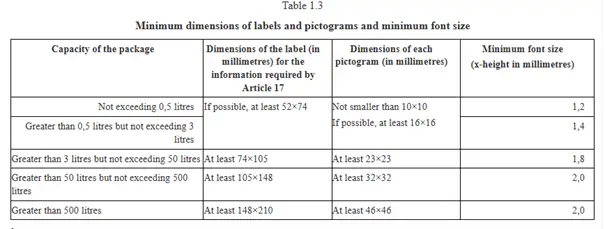
- The text will be printed in black on a white background.
- A sans-serif, single, and easily readable font will be used.
- The line spacing between two lines must be at least 120% of the font size.
- Letter spacing should be suitable for the selected font to ensure readability.
For inner packages with a capacity not exceeding 10 ml, a smaller font size than the above requirement can be used as long as it remains easily readable. This is particularly important for placing critical statements such as hazard or EUH statements, provided the outer packaging meets the requirements of Article 17 of the CLP Regulation.
Label Content
Following the introduction of new hazard classes for endocrine disruptors, persistent, bioaccumulative, and toxic/very persistent and very bioaccumulative (PBT/vPvB), and persistent, mobile, and toxic/very persistent and very mobile (PMT/vPvM) substances, if these substances contribute to the classification of a mixture, this must also be indicated on the label.
In cases where exemptions from labeling and packaging requirements apply due to the size, shape, or form of the packaging making it impossible to meet the general rules for labeling application, the minimum information requirement on the label of the inner package has been increased from four to five elements, with new elements added as warning words (Annex I, Section 1.5.1.2).
Additionally, the revised Section 1.5.2.4.1 specifies the conditions under which label elements required by Article 17 of the CLP Regulation can be omitted from inner packaging if the content does not exceed 10 ml.
To ensure safety and the protection of human health, the revised Sections 3 and 5 of Annex II of the CLP introduce specific rules for labeling and packaging of substances or mixtures supplied via refueling stations and in bulk, including special requirements for fuel filling stations.
While the original CLP Regulation allowed the use of fold-out labels when general labeling application rules could not be met due to the size, shape, or form of the packaging, the revision provides more flexibility by approving their regular use. These fold-out labels must comply with formatting rules and meet specific requirements for the content on the front, inside, and back pages as outlined in the newly added Section 1.2.1.6 of Annex I of the CLP.
According to the newly added Article 34a, digital labels may be used in addition to physical labels. Access to digital labels can be provided through a data carrier firmly attached to or printed on the physical label or packaging. While mandatory label elements specified in Article 17 of the CLP must be included on the physical label, suppliers may choose to provide additional information outlined in Article 25(3) exclusively on the digital label. In such cases, the physical label must include the statement “Further hazard information available online” or a similar indication to accompany the data carrier. The formatting requirements for digital labels are outlined in Article 34b of the amendment.
To ensure the safety and protection of human health and the environment, advertisements for hazardous substances and mixtures must include the most critical information. All such advertisements (with exemptions for non-visual media) must display hazard pictograms, signal words, hazard statements, and additional EUH statements, where applicable. Furthermore, any advertisement for such substances or mixtures sold to the public must include the statement: “Always follow the information on the product label.”
For distance sales, the label elements of a hazardous product must be clearly and visibly indicated in online listings.
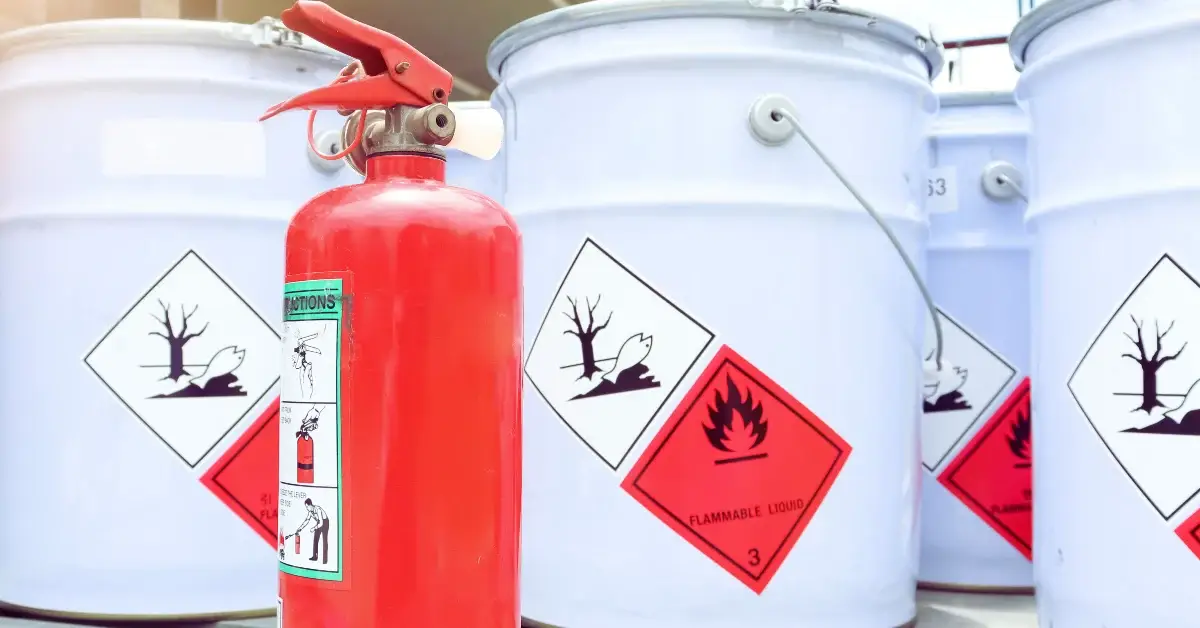
Updating Label Information
The revision outlines the obligation for suppliers to update their labels following any change in the classification or labeling of their substances or mixtures (Article 30). The deadlines specified are as follows:
- For changes resulting in a new hazard class, a more severe classification, or requiring new additional information on the label, the supplier must update the label without undue delay and no later than six months after obtaining the new assessment results.
- For other changes in classification or labeling, the supplier must update the label without undue delay and no later than 18 months after obtaining the new assessment results.
- If the change in classification or labeling arises from a harmonized classification and labeling covered by an ATP, the date(s) specified in the ATP take precedence.
- For substances or mixtures subject to the detergents or biocides regulations, the date(s) specified in those regulations take precedence.
Poison Center Notification
The Regulation introduces an obligation for distributors to provide emergency health response information to appointed bodies when distributing hazardous mixtures across member states, rebranding, or re-labeling mixtures. This obligation does not apply if distributors can demonstrate that the same information has already been submitted to the relevant appointed body by importers or downstream users in their supply chain.
Other Changes
The Regulation makes changes to the harmonized classification and labeling (CLH) process, such as prioritizing groups of substances. It also enables the Commission to initiate classification proposals in the future (Articles 36–38).
Regarding C&L notifications, future submissions must include reasons for deviations from the most severe classification or explanations for introducing more severe classifications per hazard class compared to those already included in the inventory (Article 40).