
Label Validation
Why Label Validation Matters
For companies that manufacture or place chemical products on the market, the label is one of the most important communication tools at the point where the product meets the user.
The label content guides the end user and helps them recognise and understand the product. This allows users to take the necessary precautions against the product’s potential hazards to human health and the environment.
What Does a Hazard Label Contain?
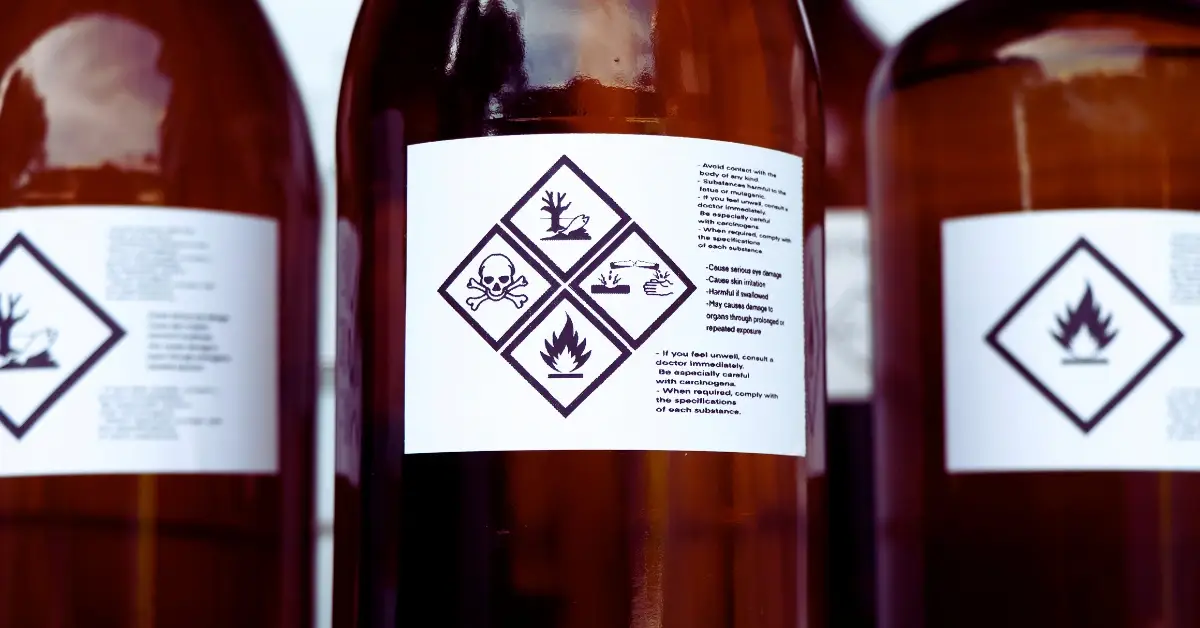
In addition to the pictograms, the label contains an explanation of what it means (hazard statement). The same pictogram might have multiple hazard statements associated with the effects that the substance or mixture might cause. For example, the exclamation mark symbol might mean that the substance or mixture may cause respiratory irritation or that it may cause serious eye irritation or skin irritation.
You will also find precautionary statements on the label, which indicate how to handle the product safely and what measures you should take if you are exposed to the product by accident.
The label also contains a “signal word” that indicates the severity of the damage a product may cause: “Danger” for more severe damage and “Warning” for less severe.
Products containing these labels may cause harm if not handled correctly.
Make sure you learn what the labels mean and read the instructions to ensure safe use.
Preparing labels in line with the legislation is a legal obligation for manufacturers, importers, downstream users and distributors that place products on the market. Doruksistem’s label validation service makes sure your labels comply with the Turkish CLP (SEA) Regulation, the product classification and the Safety Data Sheet.
You can find ECHA’s infographic on hazard pictograms at the link below:
What Is Label Validation?
Label validation is an independent expert check of a chemical product label against the Turkish CLP Regulation (SEA), the product’s current hazard classification and its Safety Data Sheet (SDS), followed by corrections where needed. The label elements must match Section 2 of the SDS exactly; otherwise the product may fail inspections and users may receive incorrect information.
The Regulation on the Classification, Labelling and Packaging of Substances and Mixtures (SEA) was published in the Official Gazette of 11 December 2013, No. 28848 (duplicate issue). Its consolidated text and annexes, including an English version, are available on the legislation page of the Ministry of Environment, Urbanisation and Climate Change Chemicals Helpdesk.
8 Label Elements Required Under the Turkish CLP (SEA) Regulation
Under Article 19 of the SEA Regulation, the label of a hazardous substance or mixture placed on the market in packaging must include:
- Supplier details: name, address and telephone number;
- Nominal quantity: for packages made available to the general public, unless specified elsewhere on the package;
- Product identifiers (Article 20);
- Hazard pictograms (Article 21);
- Signal word: “Danger” or “Warning” (“Tehlike” or “Dikkat” on Turkish labels) (Article 22);
- Hazard statements (H statements) (Article 23);
- Precautionary statements (P statements) (Article 24);
- Supplemental information (Article 27), where applicable.
Labels of hazardous substances and mixtures placed on the Turkish market must be in Turkish. Suppliers may use additional languages, provided the same details appear in all languages.
Our Label Validation Process
- Classification check: We verify the hazard classification under the SEA Regulation based on the product composition and its SDS.
- SDS – label consistency: We compare the pictograms, signal word, H and P statements on the label with subsection 2.2 (label elements) of the SDS.
- Label text and precedence rules: We check the precedence rules for pictograms, H and P statements (Articles 28–30) and make sure the Turkish statements match the official wording exactly.
- Layout and legibility: We assess label placement, pictogram size and legibility (Articles 33–34, Annex 1) and apply the exemptions in Article 31 for small packages.
- Packaging requirements: Where required, we check packaging requirements such as child-resistant fastenings and tactile warnings of danger.
- Reporting: We report any non-conformities and provide corrected label text and a design proposal.
When Should Labels Be Updated?
Under Article 32 of the SEA Regulation, the supplier must update the label without undue delay when a change in classification makes the hazard more severe or when new supplemental label information is required. In practice, label validation should be repeated when:
- the product formulation or component concentrations change (Article 17),
- the Safety Data Sheet is revised,
- the harmonised classification of a component or the relevant legislation changes,
- the product is launched in a new pack size or a new market.
For export products, the label must also be adapted to the language and legislation of the destination country (for example, the CLP Regulation in the EU).
What Can Doruksistem Do for You?
- We verify the hazard classification under the Turkish CLP (SEA) Regulation and prepare transport classifications
- We check that the product composition matches the production formulation
- We ensure consistency between the label and the Safety Data Sheet (SDS)
- We identify and edit hazard statements (H statements)
- We identify and edit precautionary statements (P statements)
- We assess packaging compliance
- We ensure correct information on product quantity (weight, volume, number of units)
- We analyse and edit the signal word and hazard pictograms
- We check compliance with the legislation
- We bring labels into line with the Turkish CLP (SEA) Regulation and GHS
- We provide technical Turkish translation and regulatory adaptation for imported products
- We adapt labels of export products to the language and legislation of the destination country
- And more
Price: Get advice from our expert and request a quote.